Table of Contents
The following text was generated using NotebookLM by drawing on Edgar Allan Poe’s literary works and critical essays written about his fiction and thought. Its aim is to explore and shed light on the possible intellectual and aesthetic intersections between Poe’s recurring themes, such as the uncanny, guilt, the subconscious, and psychological disintegration, and the language of psychological horror found within the Silent Hill universe. Rather than asserting a claim of direct influence, this work seeks to offer an analytical and interpretive reading that traces how these two dark narrative worlds converge at similar emotional and conceptual depths.
Tracing Edgar Allan Poe's Ghost in the Fog of Silent Hill
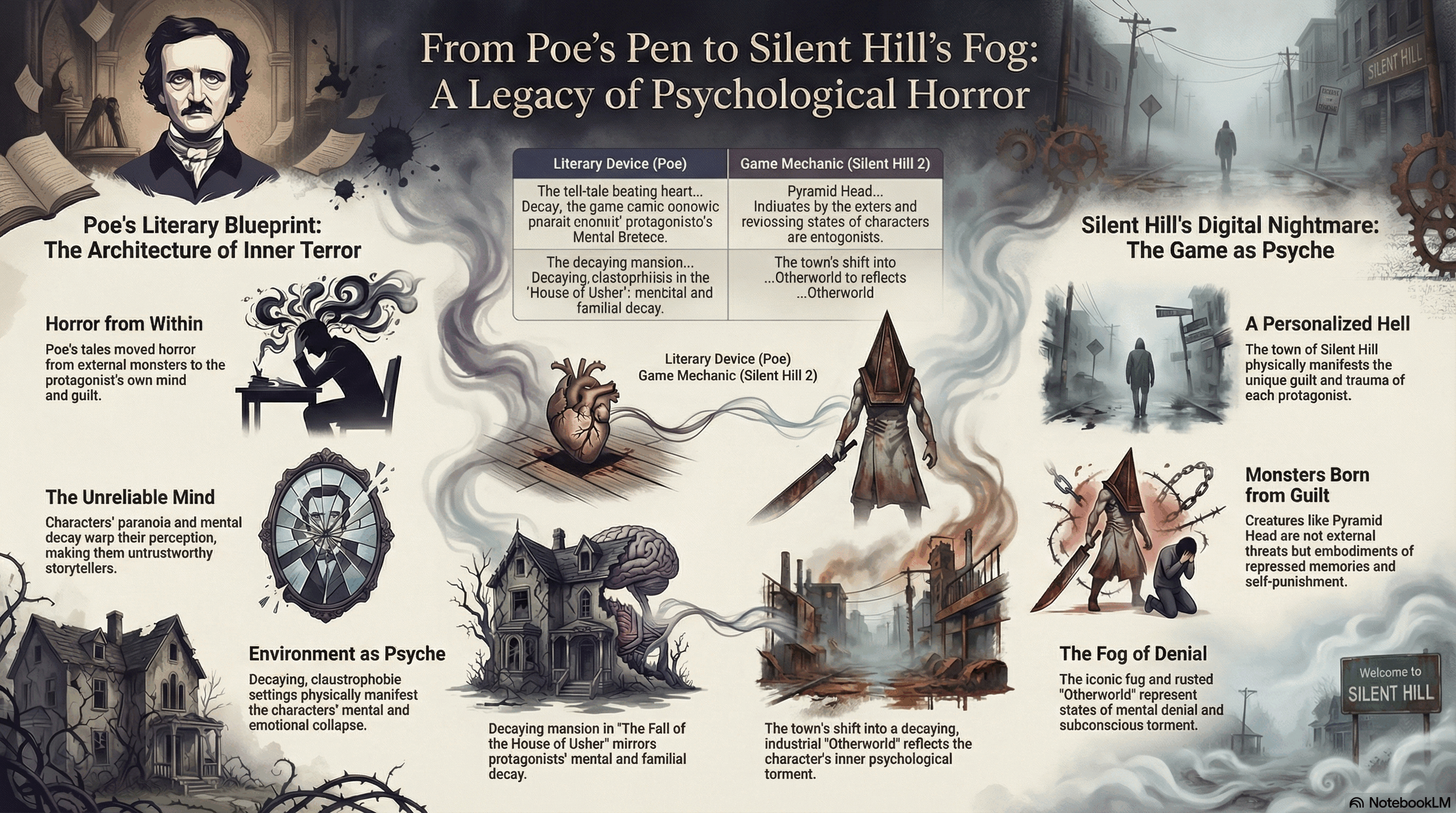 Over a century separates the gaslit interiors of Edgar Allan Poe’s fiction from
the fog-drenched streets of the digital town of Silent Hill. Yet the distance
(historical, cultural, technological) can feel strangely thin once you step into
both worlds. Poe’s narrators speak as if they are confessing into a candle’s
last flame, trembling with certainty and doubt in the same breath. Silent Hill’s
protagonists walk as if the town itself is listening, waiting for a thought to
slip and become architecture. Despite the chasm of time and medium, the series
feels like a modern inheritor of the psychological horror tradition Poe helped
crystallize: terror that blooms from within, not from some neatly externalized
monster.
Over a century separates the gaslit interiors of Edgar Allan Poe’s fiction from
the fog-drenched streets of the digital town of Silent Hill. Yet the distance
(historical, cultural, technological) can feel strangely thin once you step into
both worlds. Poe’s narrators speak as if they are confessing into a candle’s
last flame, trembling with certainty and doubt in the same breath. Silent Hill’s
protagonists walk as if the town itself is listening, waiting for a thought to
slip and become architecture. Despite the chasm of time and medium, the series
feels like a modern inheritor of the psychological horror tradition Poe helped
crystallize: terror that blooms from within, not from some neatly externalized
monster.
This is not an argument for direct influence, nor a claim that Team Silent “adapted” Poe. It is closer to a mapping of shared techniques and shared obsessions: how dread is paced, how guilt becomes a sound in the walls, how a setting can behave like an unstable mind, and how a story can be built so that the audience is never sure whether they are witnessing a haunting, or participating in one. In short, it is an interpretive attempt to show how Silent Hill translates foundational principles of 19th-century Gothic terror into an interactive grammar.
If Poe’s great innovation was to treat consciousness itself as a haunted house, Silent Hill’s great innovation was to let you walk its halls.
1. The Architects of Psychological Terror
To understand the lineage connecting Edgar Allan Poe and the Silent Hill series, it helps to see them as parallel architects of psychological terror, each defining what “horror” can do in their medium. Poe built with ink and cadence; Team Silent built with camera angles, fog shaders, sound design, and the uneasy rhythms of player control. Their shared genius lies in prioritizing the internal landscape of fear over external threats. Even when monsters appear, the true engine of dread is perception: what the mind believes, what it refuses to admit, what it cannot stop replaying.
Poe, a central figure in American Romanticism and Gothic fiction, is celebrated for tales of mystery and the macabre, but his most unsettling stories rarely depend on the supernatural. He shifts the locus of fear inward. In “The Tell-Tale Heart,” terror is a tempo: the narrator’s insistence on sanity becomes its own indictment, and the story accelerates until sound itself feels weaponized. In “The Black Cat,” confession turns into self-justification, and self-justification turns into self-exposure. In “William Wilson,” doubling becomes moral vertigo: the self is pursued by a self, not as metaphor but as felt pressure.
Poe’s technique matters as much as his themes. He often writes as if he is building an effect first and then selecting every detail to serve it, a philosophy he would later articulate explicitly in “The Philosophy of Composition.” His prose uses repetition, rhythmic emphasis, sudden pivots, and heightened attention to sensory details to mimic the agitation, fixation, and mania of his narrators. The terror is not only in what happens; it is in how the mind insists on describing what happens.
Generations later, Silent Hill emerged as a landmark in psychological horror for video games by refusing to treat fear as an “encounter” you win. It deprioritized combat in favor of atmosphere, narrative, and investigation, and it leaned into a premise of psychological depth: the town behaves like a projection surface, manifesting a personalized nightmare that feels less like a plot twist and more like a law of nature. In interviews, the developers describe a fascination with realism filtered through dream logic, fragments of memory reconstructed into a playable place.
Here is the evolutionary leap. Where Poe uses rhetoric to convey a character’s inner turmoil, Silent Hill uses game design. The series translates agitated prose into fog, soundscapes, camera control, and spaces that seem to respond to guilt. Monsters are not merely “symbolic.” They function as interactive pressure: a force that makes the player move, hesitate, look away, and most importantly, continue.
This shared methodology, projecting the psyche outward, finds its most potent expression in environment and sensation: spaces where the very fabric of reality becomes a mirror held too close to the face.
2. The Uncanny and the Haunted Space: From the House of Usher to the Otherworld
Setting in horror is never merely a backdrop; it is an instrument. Both Poe and the creators of Silent Hill weaponize place through the uncanny: the unsettling sensation produced when the familiar turns strange without fully becoming “other.” The uncanny does not announce itself with a roar. It arrives as a subtle mismatch: an ordinary hallway that feels slightly too long, a room arranged like a memory rather than like a room, a street corner that should reveal a landmark but instead reveals only fog.
In “The Fall of the House of Usher,” Poe transforms a family mansion into a living tomb. The house is more than setting; it is an externalized nervous system. Its “insufferable gloom,” its fissures, its stagnant tarn; these are not decoration, but an atmosphere that appears to think. Criticism has often noted Poe’s use of reflection and doubling in the story: the house mirrored in water, the twins as living reflections, the narrator’s own shifting perception. The mansion becomes a kind of psychological diagram. You can feel that the building is not simply decaying; it is participating in the family’s collapse.
Poe’s genius is in how he makes the reader hold two realities at once: the house is physically present, and the house is also a mind. The story never forces you to choose between those interpretations. The ambiguity is the point.
Silent Hill takes this concept and makes it navigable. The series’ iconic “Otherworld,” a nightmarish parallel layer that consumes the ordinary town, transforms it into corridors of rust, wet metal, stained tile, and industrial decay. It is uncanny space made playable. The crucial transformation is experiential: the player does not observe the metaphor; the player survives inside it.
Even Silent Hill’s most famous aesthetic choice, its fog, is a perfect example of how technical constraint becomes psychological tool. The fog began as a practical solution to limited draw distance, but it fits the series’ dream logic with eerie precision. It turns the town into a boundary condition: you can move forward, but you cannot know what forward contains. That uncertainty is not merely visual. It is moral. It suggests that your future is obscured for the same reason your past is: because the mind does not want to see too far.
The opening of Silent Hill 2 is exemplary in its patience. Before the game becomes overtly hostile, it invites you into the town with an almost mundane stillness: trees, roads, distant shapes, the sensation of entering a place that should be familiar but isn’t. It is less a “walk into danger” than a quiet ritual of disorientation. The player is being tuned, like an instrument, to accept that this world will not behave like a stable world.
Thus, both Usher’s mansion and Silent Hill’s Otherworld serve as architectural mirrors for the soul: mirrors shattered not by a villain’s hand, but by grief, fixation, and the slow violence of denial.
Where Poe can make the reader feel that a building is thinking, Silent Hill can make the player feel that thinking is a building.
3. A Legacy of Loss: The "Death of a Beautiful Woman"
The trope of mourning a lost loved one is a persistent and powerful engine in horror, because grief is already a kind of haunting: a presence that is absent, a voice that only speaks inside your head, a replay that cannot be turned off. Both Poe and Silent Hill 2 seize upon this engine not to manufacture melodrama, but to explore the way love and guilt can become indistinguishable once memory starts rewriting itself.
Poe repeatedly returns to the image of the dead beloved as an aesthetic and psychological obsession. In “Ligeia,” the narrator admits that his memory is “feeble through much suffering,” immediately destabilizing the account. The beloved returns not as a straightforward ghost, but as a gravitational force that bends reality: remembrance becomes a kind of necromancy. In poems like “The Raven” and “Annabel Lee,” grief is staged as a rhythm: refrains that do not merely express mourning, but enact it.
Poe is even explicit about the mechanism. In “The Philosophy of Composition,” he claims that the most melancholy topic becomes most poetical when allied with beauty: “the death, then, of a beautiful woman.” Whether one agrees with this aesthetic claim or not, it reveals something useful for reading Poe: he understood how loss can become a self-perpetuating structure, a loop of longing and self-torment that the mind returns to because it cannot resolve it.
This framework becomes the backbone of Silent Hill 2. James Sunderland is drawn to the town by a letter from his wife Mary, who died years earlier. The premise is simple enough to be mythic: an impossible message from the dead. But the story’s power comes from how relentlessly it refuses to let the message remain comforting. Silent Hill turns the longing for reunion into a mechanism of exposure. James’s journey is not a quest for external truth so much as a forced encounter with what he has repressed: resentment, exhaustion, tenderness, shame, and the unbearable weight of choices made in the long shadow of illness.
The game’s most devastating move is how it literalizes the way grief “splits” a person. Mary is memory, idealization, accusation, and longing. Maria, her doppelgänger, is not merely a twist; she is a symptom: a projection that feels like wish fulfillment but behaves like a trap. In Poe’s work, doubling often signals moral fracture (“William Wilson”) or the return of what the self wants to disown. Silent Hill gives this doubling a body you can walk beside, protect, lose, and meet again.
In both worlds, trauma is not merely remembered; it is productive. It generates settings, figures, and compulsions: monsters made of whatever the mind refuses to say aloud.
4. Monsters from the Id: Guilt, Trauma, and the Subjective Beast
In psychological horror, the most terrifying monsters are not alien creatures or supernatural demons, but reflections of our own hidden natures: guilt, trauma, and desire given flesh and teeth. This principle is a powerful throughline connecting Poe’s tormented narrators to the literal monsters of Silent Hill, which feel less like enemies than like accusations.
Poe’s characters are rarely threatened by external forces; they are the source of their own horror. In “The Tell-Tale Heart,” paranoia is a metronome. In “The Black Cat,” cruelty is rationalized until rationalization collapses into confession. In “The Pit and the Pendulum,” the body becomes a clock that measures fear, slice by slice. Poe’s genius was to make the reader inhabit the narrator’s internal logic long enough to feel its seductive coherence, then to watch it rot from the inside.
Silent Hill takes this literary concept and literalizes it in creature design, environment, and mechanics. The monsters stalking the town are not random wildlife; they are a personalized bestiary shaped by inner conflict. Commentary around the series often notes parallels with Francis Bacon’s distorted figures: bodies that look like they are being reshaped by invisible pressure. Regardless of the exact chain of influence, the resemblance is useful as interpretation: Silent Hill’s creatures often appear mid-transformation, as if the psyche is still deciding what it wants to show.
Silent Hill 2 in particular is a masterclass in symbolic design:
- Pyramid Head: The game's iconic executioner, Pyramid Head is the brutal embodiment of James's guilt and his subconscious desire for punishment. Based on the town's fictional history of executioners, he is an unrelenting judge, his violent acts mirroring James's own repressed aggression and sexual frustration.
- Bubble Head Nurse: A grotesque reflection of James's hospitalization trauma, these convulsing, faceless figures symbolize his corrosive mixture of sexual desire and resentment. Their design captures the conflict of caring for a sick spouse while being consumed by forbidden urges.
- Mannequin: A creature born of James's fractured gaze, the Mannequin literalizes his sexual frustration into a twitching, headless form: all legs and no identity, a perfect symbol of objectification. It is a hostile sculpture representing his inability to see women as anything but fragmented parts.
What makes these designs especially potent is not the symbolism alone, but how the player must respond to them. You are not asked to “understand” guilt; you are asked to move under its pressure, to manage distance, to decide when to fight and when to flee, to feel your own body tense when the town decides it is time.
This principle of a subjective reality, where one's inner state dictates the physical world, is presented through a narrative lens that is just as unstable and personal.
5. Through a Glass, Darkly: Unreliable Narration and Perceptual Terror
The unreliable narrator is one of the most potent weapons in the psychological horror arsenal. By forcing the audience to question the reality of events, it creates an unease no single monster can replicate. It traps you in perceptual vertigo: the narrative itself becomes the threat.
Poe was a master of this technique. His narrators insist on their sanity, on their logic, on the reasonableness of what they have done, then reveal, through the very effort of insisting, that something is irreparably wrong. In “The Tell-Tale Heart,” the narrator’s obsession with precision reads like competence until it becomes compulsion. In “The Black Cat,” the narrator’s moral framing shifts so often that the reader begins to feel the story sliding under their feet. In “Ligeia,” the admission of “feeble” memory functions like a crack in the foundation: everything after it is haunted by the possibility that the tale is a symptom.
Silent Hill translates this device into interactive form by placing the player inside an unreliable subjectivity. The innovation is not merely that the protagonist may be mistaken. It is that the player’s own perceptions become suspect because they are operational: you are making choices based on what you see and hear. If those inputs are compromised, then your agency becomes part of the horror.
The series makes this explicit through contrast. In Silent Hill 2, Laura experiences the town differently, unbothered by monsters, suggesting that the environment is not a universal “curse” but a personalized construction. In Poe, the reader stands outside the narrator and weighs credibility. In Silent Hill, you are inside the system that produces the credibility problem.
This is what turns familiar horror beats into something more intimate. In a film, you can watch a character deny the truth. In a game, you can be made to enact that denial as forward progress.
These interconnected themes are not mere echoes; they are evidence of a living tradition being reinterpreted through new tools such as camera, sound, interactivity, and the unique intimacy of control.
6. Sound as Conscience: Industrial Dread, Silence, and the Radio
If Poe’s prose can make sound feel like moral pressure (heartbeats, floorboards, whispered repetitions), Silent Hill’s sound design can make moral pressure feel like the air itself. Developers have described resisting “cinematic” music and instead building a sonic world that feels as if it could exist in that town: distant industrial groans, abrupt mechanical rhythms, and stretches of near-silence where the player becomes hyperaware of footsteps and breath.
Akira Yamaoka’s approach is especially important here. In interviews, he describes wanting to differentiate Silent Hill from other games and to use atmosphere and noise rather than predictable background music. The result is a sonic landscape that behaves like anxiety: it flares, recedes, and returns at the exact moments your imagination begins to fill in what you cannot see.
The radio static mechanic is a brilliant example of horror translated into design logic. It serves as a warning system, but it also damages the player’s nerves by producing constant anticipatory tension. You are not surprised by the monster because the game has told you it is near; you are exhausted by the waiting, by the inability to locate what the warning refers to. This is Poe’s method in a different register: dread as sustained attention, sustained attention as torment.
And then there is silence, the rarest, most violent sound cue in Silent Hill. Silence is the moment when you realize you have been relying on noise to orient yourself, and now orientation is gone.
7. Mechanics as Rhetoric: How Games Make Guilt Playable
Poe’s stories often feel like arguments delivered by unstable minds. The narrators persuade, rationalize, rehearse. Silent Hill adapts this rhetorical structure into mechanics: systems that make you perform the logic you might otherwise only read about.
Consider how many design decisions in Silent Hill privilege vulnerability over mastery:
- Limited visibility (fog, darkness, cramped interiors) makes knowledge scarce.
- Awkward combat and constrained resources make control imperfect.
- Maps and navigation turn “being lost” into a repeated activity rather than a single scene.
These are not simply gameplay features; they are rhetorical devices. They instruct the player’s body to feel what the story is about. A mind trapped in guilt does not move cleanly. It circles, returns, re-enters the same spaces with a different interpretation.
Poe can write a sentence that loops on itself. Silent Hill can make you walk a corridor that feels like the sentence.
Conclusion: A Tradition Reborn in Pixels
From the crumbling manor of the Ushers to the rust-stained corridors of Brookhaven Hospital, a clear and chilling lineage runs from Poe to Silent Hill, not as a straight line of influence, but as a shared obsession with inner life as the true site of terror. Poe shows how a mind can narrate itself into damnation. Silent Hill shows how a mind can build a town.
Both works treat horror as an effect produced by attention: what you cannot stop looking at, what you cannot stop listening to, what you cannot stop returning to. Both turn the uncanny into a method by corrupting the familiar until it becomes unbearable. Both understand that loss is not a single event but a machine that keeps producing images. And both insist that the most frightening monsters are the ones that resemble us, not in appearance, but in origin.
Silent Hill’s primary innovation is not merely that it “updates” Gothic themes. It invents a grammar for interactive psychological horror. Fog becomes uncertainty you must navigate. Sound becomes conscience. Combat becomes a clumsy argument between desire and fear. The Otherworld becomes the inside of a thought, rendered with rust and fluorescent light.
In that sense, Poe’s ghost does not simply linger in Silent Hill’s streets. It is reconstituted as a design philosophy: a commitment to dread as intimacy, and to horror as a mirror that does not flatter. And when the player presses forward, despite the fog, despite the radio static, and despite the feeling that the town is watching, the tradition is reborn once again: not as a story you read about the darkness within, but as a path you are made to walk through it.