Table of Contents
GitHub Account Notifications to Gotify with n8n
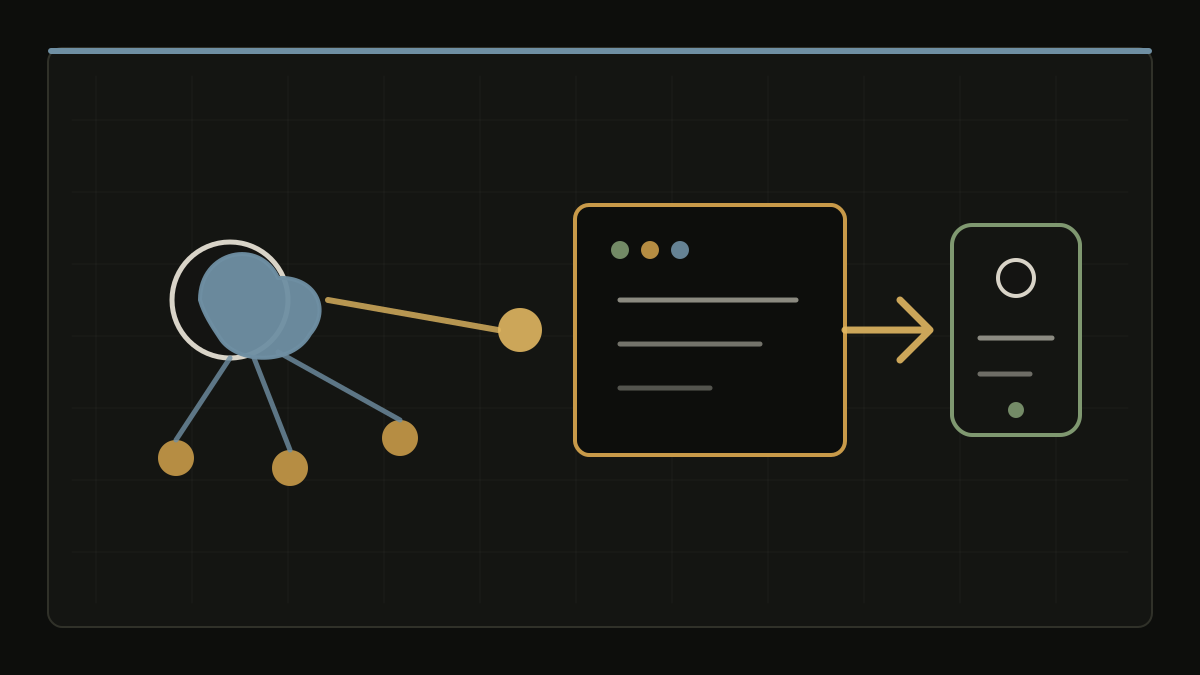
This guide configures a GitHub App to send repository activity from a personal account or organization to the Gotify Android app through an importable n8n workflow. n8n sends events to the Gotify server, and the Gotify app receives them as real-time Android notifications on the phone.
It uses the released workflow JSON from sametcn99/n8n-automations, not a locally built or hand-edited workflow.
The workflow formats GitHub webhook payloads into compact phone notifications with an event title, useful context, and a direct GitHub link. It supports pushes, pull requests, issues, comments, workflow runs, releases, stars, watches, forks, ref changes, and other documented GitHub webhook events that the installed GitHub App is allowed to receive.
Architecture and Scope
The event path is:
In Gotify terminology, n8n is an application that can send messages. The phone is a separate client that receives those messages from the Gotify server. Creating the Gotify application token configures the sending side; it does not by itself configure a phone to receive notifications.
GitHub does not offer a general webhook for all activity on a personal user account. A repository webhook covers only one repository and an organization webhook covers only one organization.
To cover repositories belonging to an account, create a GitHub App, install it on the target account, and choose All repositories. New repositories are included while that installation remains scoped to all repositories.
This is not a feed of every action performed by a GitHub user. GitHub only sends events supported by GitHub Apps, enabled under the App's event subscriptions, and available through the App's repository or organization permissions. The App cannot observe repositories that the account does not own or administer.
Prerequisites
Before starting, make sure you have:
- A GitHub account or organization where you can create and install a GitHub App.
- A public HTTPS URL for an n8n instance. GitHub must reach its production webhook URL from the internet.
- An n8n instance where you can import and activate workflows and create Gotify credentials. n8n Cloud and Community Edition are both suitable.
- A running Gotify server, a user account, and permission to create an application token.
- An Android phone with the official Gotify app installed from Google Play, F-Droid, or the latest GitHub release.
Do not put Gotify tokens, webhook URLs, or production workflow exports in a public repository.
Step 1 - Download the Released Workflow JSON
Open the latest GitHub release
and download the github-gotify.json asset. The repository rebuilds this JSON
from its TypeScript source during release publication, so the release asset is
the supported import artifact.
You can also use this download URL:
Release assets intentionally contain this placeholder instead of a real secret:
That is expected. Each installation must replace it with its own random value before importing the workflow.
For repeatable production rollouts, retain the exact release URL or release tag you approved in your deployment documentation. Review workflow changes before upgrading to a newer release.
Step 2 - Generate a Webhook URL Secret
This workflow protects its endpoint with an unguessable path. Generate a unique 64-character lowercase hexadecimal value, which provides 256 bits of random entropy.
Windows PowerShell
macOS or Linux
Python 3
On Windows systems where python3 is unavailable, use python instead.
Replace every occurrence of <long-random-secret> in the downloaded
github-gotify.json file with the generated value. The final n8n webhook path
must look like this:
The path is effectively a password. Never send it in chat, screenshots, logs, or source control. Use a distinct value for each environment and rotate it immediately if it is exposed.
Step 3 - Create a Gotify Application and n8n Credential
- Sign in to the Gotify server.
- Create an application, for example GitHub Notifications.
- Copy the application's generated token.
- In n8n, create a Gotify credential.
- Enter the Gotify server URL and application token in that credential.
Keep the token in n8n's credential store. Do not add it to the workflow JSON, the Code node, or notification content. Using a dedicated Gotify application for this integration makes token rotation and message management easier.
Step 4 - Connect the Gotify Android App
The official Gotify Android app maintains a connection to the Gotify server and displays a device notification whenever the server receives a new message. Install the app and connect it before testing the GitHub workflow:
- Open the Gotify app on the Android phone.
- Add the public HTTPS URL of the Gotify server.
- Sign in with the Gotify user account that owns the GitHub Notifications application created in Step 3.
- Allow Android notification permission when prompted.
- Send a test message from the Gotify server's web interface and confirm that it appears immediately as an Android notification.
The phone needs network access to the Gotify server. For reliable background delivery, exclude Gotify from the device's battery optimization or unrestricted battery restrictions. Some Android vendors terminate background connections aggressively; their device-specific guidance is available at DontKillMyApp.
The app's persistent foreground connection indicator is normal. It keeps the real-time notification channel alive while the app is running in the background.
Step 5 - Import and Activate the n8n Workflow
- In n8n, create a new workflow or open the import screen.
- Import the edited
github-gotify.jsonfile from Step 2. - Open the Send to Gotify node and select the Gotify credential created in Step 3.
- Open GitHub Account Webhook Input and verify its path contains the new
64-character secret rather than
<long-random-secret>. - Save the workflow.
- Activate the workflow.
- Open GitHub Account Webhook Input and copy its Production URL.
Use the production URL in GitHub. The n8n test URL only works while n8n is listening for a manual test request and is not a durable webhook endpoint.
If n8n is behind a reverse proxy, configure its public webhook base URL before copying the production URL. A typical configuration is:
The final URL must be public HTTPS, resolve from the internet, and pass through the proxy without rewriting its path.
Step 6 - Create and Install the GitHub App
Create the App from the target account:
- Open Settings -> Developer settings -> GitHub Apps -> New GitHub App.
- Give the App a recognizable name, such as Account Gotify Notifications.
- Paste the n8n production URL into Webhook URL.
- Leave GitHub's Webhook secret field empty. This workflow authenticates requests with the random n8n URL path instead.
- Keep webhook delivery active.
- Select Only on this account for installation access unless another account genuinely needs to install the App.
- Grant only the permissions GitHub requires for the events you select. Apply the principle of least privilege.
- Under Subscribe to events, select the events you want to receive.
- Create the GitHub App, open its install page, install it on the target account, and select All repositories.
Useful subscriptions include Push, Pull request, Issues, Issue comment, Workflow run, Release, Star, Watch, Fork, Create, and Delete. GitHub may require additional permissions before some subscriptions are available.
Selecting All repositories is what gives the App account-wide repository coverage. Revisit this installation after repository transfers, archival, or permission changes.
Step 7 - Verify the End-to-End Delivery
GitHub sends a ping webhook when the App webhook is configured. It should
produce a low-priority Gotify notification indicating that webhook delivery was
verified.
To confirm the integration:
- Open the GitHub App's webhook delivery or Recent Deliveries page.
- Open the initial
pingdelivery and confirm GitHub records a successful response. - Confirm the Gotify Android app displays an immediate device notification.
- Create a small test event, such as pushing a commit or opening a pull request.
- Confirm the Android notification has a concise summary, relevant GitHub URL, and no raw JSON payload.
Use GitHub's Redeliver action after correcting a configuration issue. Do not rotate the URL secret unless you also update the n8n path and the GitHub App's Webhook URL together.
Security and Operations
- Keep HTTPS enabled from GitHub through the n8n endpoint. Do not terminate TLS at an untrusted proxy.
- Treat the 64-character webhook path as an authentication secret. It is not included in Gotify messages.
- Limit access to the n8n workflow, workflow execution history, and Gotify application.
- GitHub event data can contain issue titles, pull request titles, comment excerpts, author names, commit messages, and URLs. Configure n8n execution retention according to your privacy and compliance requirements.
- Review the GitHub App's permissions and selected event subscriptions regularly. Fewer event types and permissions reduce exposure and notification noise.
- Rotate the random webhook path if it may have leaked: generate a new value, update the n8n Webhook node, save and activate the workflow, then immediately update the GitHub App webhook URL.
- When updating the automation, download and review a new release asset, make the same secret replacement, import it into a non-production workflow first, then switch production after successful delivery tests.
Troubleshooting
| Symptom | Likely cause | Resolution |
|---|---|---|
GitHub reports 404 or Not Found |
The GitHub App URL differs from the active n8n production URL. | Copy the production URL again from the active GitHub Account Webhook Input node. Do not use the test URL. |
| No n8n execution appears | The workflow is inactive or GitHub cannot reach the endpoint. | Confirm the workflow is active, the URL is public HTTPS, and firewall or proxy rules permit GitHub requests. |
| A request reaches n8n unexpectedly | The random URL path was disclosed. | Rotate the path in n8n and update the GitHub App's Webhook URL immediately. |
| Gotify receives no message | The Gotify server URL, application token, or selected credential is wrong. | Test the Gotify credential in n8n and verify the token belongs to the intended application. |
| The Gotify server receives a message but the phone stays silent | The Android app is disconnected, notifications are blocked, or battery optimization stopped its background connection. | Open the Gotify Android app, verify it is connected to the right server, allow notifications, and exempt it from battery optimization. |
| Only some events arrive | The App is not subscribed to those events, lacks permission, or the event is unavailable to the installation. | Review the GitHub App's event subscriptions, required permissions, and repository installation scope. |
| The copied URL is internal or invalid | n8n's public webhook URL is not configured behind the proxy. | Set the correct public WEBHOOK_URL, restart n8n if required, reactivate the workflow, and copy the production URL again. |
What You Get
Once active, the workflow turns GitHub App deliveries into concise messages on the Gotify server. The Gotify Android app receives each new message in real time and raises the device notification. Each notification identifies the event and repository, summarizes the most useful event details, and includes the best available direct GitHub link. The formatter limits large values such as commit lists, comments, and release notes, keeping routine notifications practical on a phone while preserving the link back to the full GitHub context.